24 09
14 11
2026
HIDDEN FLASH
Vladimír Véla
Curated by Jan Dotřel
The search for the essence and intrinsic qualities of the phenomena of this world is one of the most complex processes of human cognition. Our existence most likely begins in darkness. It matters little whether we conceive of this beginning from the universal perspective of the cosmos or as an embryo concealed within the body of another human being. Is this gradually developing human, curled up in warm water, capable at certain moments of perceiving some form of light? What is certain, however, is that after a time they are cast into a direct and painful light, filled with the mystery of knowledge. For an unimaginably long period, humankind as a species remained in darkness, dependent upon the natural phenomena of the astronomical regularity of day and night. A true paradigm shift, and the birth of a civilised understanding of representation, came only with the metaphorical Promethean “taming” of light.
If we turn our gaze to the ancient paintings of the Chauvet Cave in France, a perfectly sealed archaeological capsule that remained almost hermetically closed for tens of thousands of years, we encounter an extraordinary spectacle. Within it lies one of the oldest galleries in the world, an inaccessible cavern whose walls are covered with breathtaking ritual paintings of animals in various configurations, alongside numerous geometric compositions of points and lines. This fact alone constitutes an exceptional phenomenon from both archaeological and art historical perspectives.
What is particularly significant from the perspective of art history, however, is the mode of representation, which necessarily relied upon firelight cast from several different directions. The figures overlap in a non-mimetic manner, forming a fluid and organic mosaic painted from memory. The question of mimesis, or imitation, is therefore profoundly relevant to this exhibition.
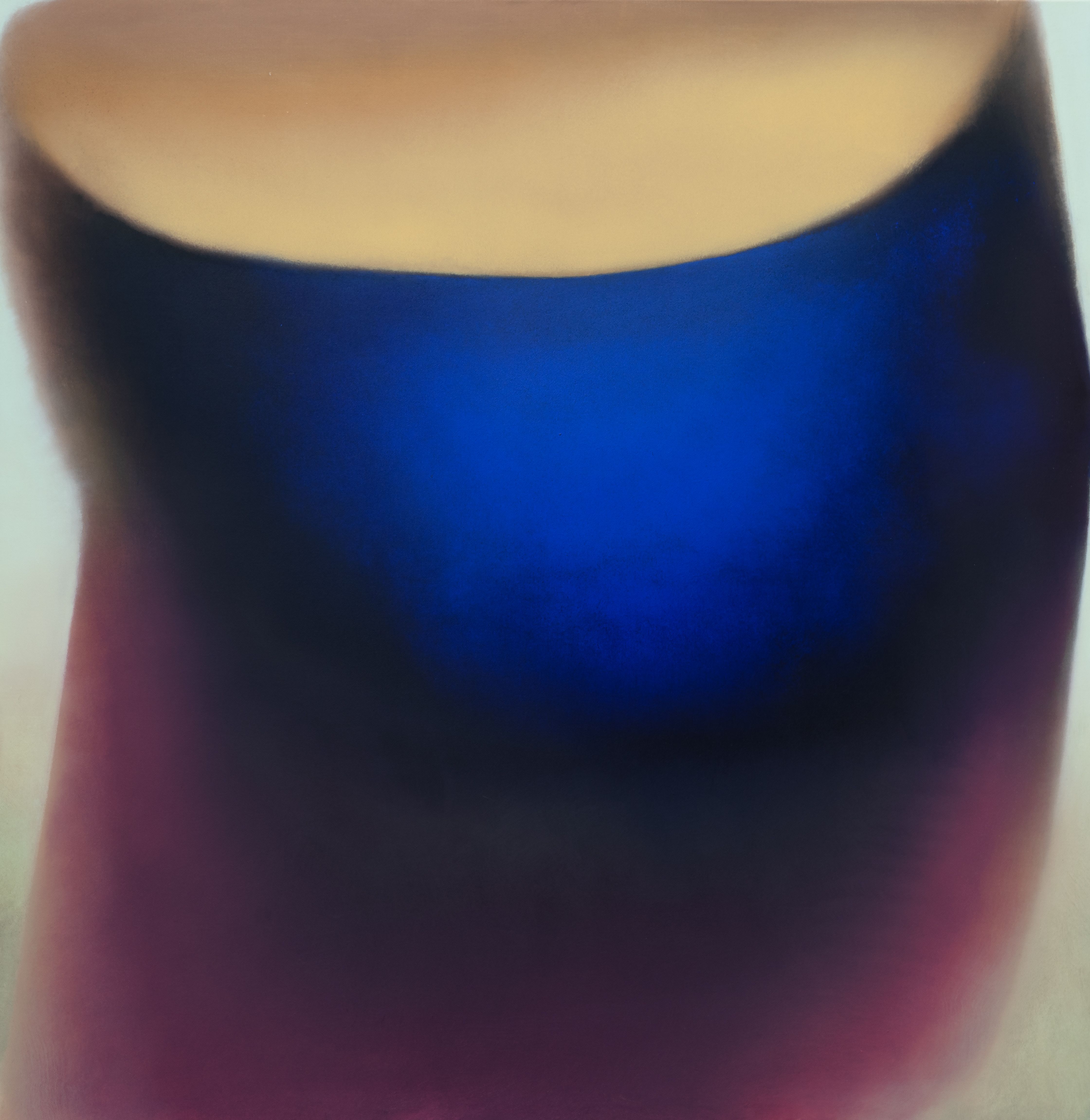
The origins of Vladimír Véla’s visual language are firmly rooted in a precise command of figurative and landscape painting, within which he developed a highly distinctive means of capturing reality. Gradually, however, his work undergoes what might metaphorically be described as a paradigm shift of its own. Without a conscious departure from mimetic painting, the image increasingly moves away from the direct depiction of reality. At one point in Véla’s practice, a tendency towards figurative animal motifs prevailed, while landscape painting, with certain facets of Fauvism, never disappeared from his work. Yet what can be said of his current practice is that it is driven by a profound desire to capture light. A light that can possess a real character, but can equally be founded upon the basis of an imagined world. The artist has long engaged with archetypal phenomena such as the tension between several points or lines, which is why, both in this text and in the installation of the exhibition, we encounter a certain primordial character of expression. If we look slowly and quietly at the subtle yet expressively bold gestures of Vladimír Véla’s paintings, we repeatedly encounter precisely this duality of light and shadow, allowing us, in the unfolding mystery of light, to move several millennia forward.
One of the most fundamental philosophical concepts concerned with a particular form of knowledge and the significance of light is the allegory, or myth, of the cave. It appears in Plato’s Republic, conceived as a multilayered dialogue devoted to social as well as purely philosophical concepts. The myth of the cave is undoubtedly one of the fundamental pillars of European abstract thought.
Through Socrates, Plato describes the lives of people chained within a cave in such a way that they are able to look in only one direction. Behind them burns a fire whose light casts shadows upon the wall, leaving the prisoners able to perceive only reflections of reality, which they take to be reality itself. The cave, however, also opens towards the Sun and the true light of knowledge.
The transformation from prisoner to philosopher becomes possible through a first painful step: enduring the glare and becoming capable of seeing the actual object rather than merely its shadow. The eyes must then acclimatise, first to the light beyond the cave and ultimately to the Sun itself. Very few are capable of undertaking this journey. Yet even those who remain within the rays of knowledge have not grasped the true meaning of the path. Its purpose is to return to the cave and, slowly, suggestively and humbly, whisper to the other prisoners that the reality surrounding them is not entirely as they presently perceive it. To show them a vessel, a horizon, at times even darkness, and then a barely perceptible, hidden flash.