24 09
14 11
2026
GROWTH BOOM
Magdaléna Roztočilová
Curated by Barbora Kundračíková
The garden is one of the oldest cultural models of the relationship between humans and the more-than-human world. It is a composed space where care carries consequences: sowing, staking and protection, but also pruning, transplanting, dividing and exclusion. The natural world emerges as a realm of continual negotiation rather than harmony. The French landscape designer Gilles Clément therefore speaks of the ‘garden in movement’, proposing that gardeners observe and accompany natural dynamics rather than impose a definitive form. Growth Boom brings this approach into sculpture, culminating in a carefully constructed form that seems ready to extend beyond its outline at any moment.
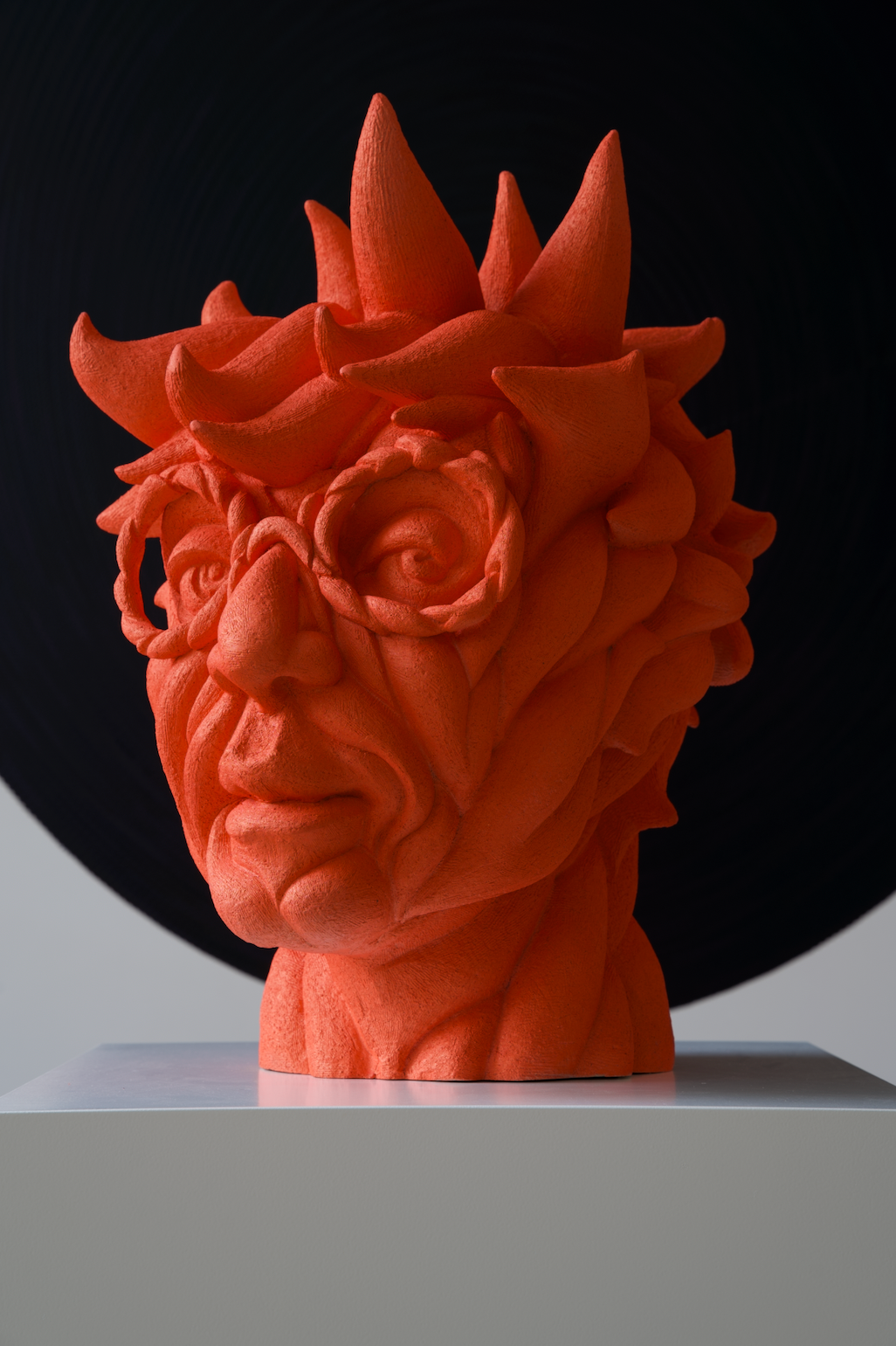
Magdaléna Roztočilová’s figures multiply faces, open into blossoms and become overgrown with flames, fabric or coloured fibres. The portrait becomes space; an inner state assumes physical form. ‘A figure with two legs and a single face has always seemed insufficient to me,’ says the artist, reaching beyond formal expansion. She also challenges the body as a stable, autonomous and clearly bounded whole. For her, the figure is a process: a temporary arrangement of diverse forces, materials and memories.
Reflection on the boundaries between the human body and vegetal forms has a rich art-historical tradition. Renaissance and Mannerist grotesques readily combined figures, animals and plants into ornamental organisms in which individual species flowed into and overlapped one another. They deserve attention beyond the category of extravagant fantasy, for hybridity may well be the fundamental condition of existence. This idea resonates through the work of numerous contemporary thinkers. Rosi Braidotti, Emanuele Coccia and Donna Haraway all explore the fluidity of life on its own terms. Donna Haraway’s essay Staying with the Trouble: Making Kin in the Chthulucene (2016) deserves particular emphasis here: it productively replaces the notion of autonomous self-making with sympoiesis, or ‘making-with’. Her call to make kin extends care beyond blood relations and the limits of our own species. In this context, Roztočilová’s figures may be understood as our own ‘speculative kin’.
Posthumanist expansion also encompasses materials. Ceramics, resin, metal and textiles resist, carry cultural memories of their own, yield to gravity, harden, crack, flex or fray. Here we encounter Jane Bennett and her concept of ‘vibrant matter’, as old – in the best sense – as the world itself. The evident elemental vitality of Magdaléna’s objects emerges from a negotiation between at least two active – and passionate – interlocutors, each possessing its own knowledge and potential.
An important literary and visual genealogy for the exhibition is Čapek’s The Gardener’s Year (1929), which turns the cultivator’s supposed sovereignty into comic dependence on the seasons, weather and wilful organisms. More pertinent still are Čapek’s understated photographs of cacti, establishing the plant as portrait, architecture or small monument. Like him, Roztočilová steers between attentive care and vegetal revolt, keeping idyll and catastrophic pathos at a distance. For her, growth may be regenerative or excessive, creative or invasive. The title Growth Boom thus evokes accumulated vital forces whose form remains open, relational and unpredictable. This time the exhibition’s centre of gravity quite literally lies – what a relief – in an autonomous sculptural language capable of giving precise, lasting form to an open, relational body. Gardener, garden, matter and form cultivate one another as their boundaries merge. Indeed, every garden surrounds us with other lives.